
Product Overview
| Product Name | Zenmuse L1 |
| Dimensions | 152 × 110 × 169 mm |
| Weight | 930 g ± 10 g |
| Power Consumption | 30 W typical, 60 W max |
| IP Rating | IP54 (Dust & Water Resistant) |
| Supported Drone | DJI Matrice 300 RTK |
| Operating Temperature | -20°C to 50°C |
| Storage Temperature | -20°C to 60°C |
| LiDAR Accuracy | 3 cm @ 100 m |
| Detection Range | Up to 450 m (80% reflectivity) |
| Point Rate | Max. 480,000 pts/s (multiple returns) |
| RGB Camera | 1-inch CMOS, 20 MP |
| Photo Resolution | 5472 × 3648 max |
| Video Resolution | 4K @ 30p (H.264) |
| Aperture Range | f/2.8 – f/11 |
| Shutter Speed | 1/8000 – 8s (Electronic), 1/2000 – 8s (Mechanical) |
| IMU Accuracy | Yaw: 0.3° RTK, 0.15° Post-process |
| Point Cloud Modes | Reflectivity, Height, Distance, RGB |
| Data Storage | microSD up to 256 GB (UHS-I, Speed Grade 3) |
| Compatible Software | DJI Terra – supports PNTS/LAS/PLY/PCD/S3MB |
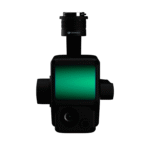
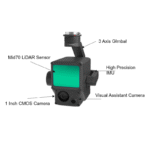
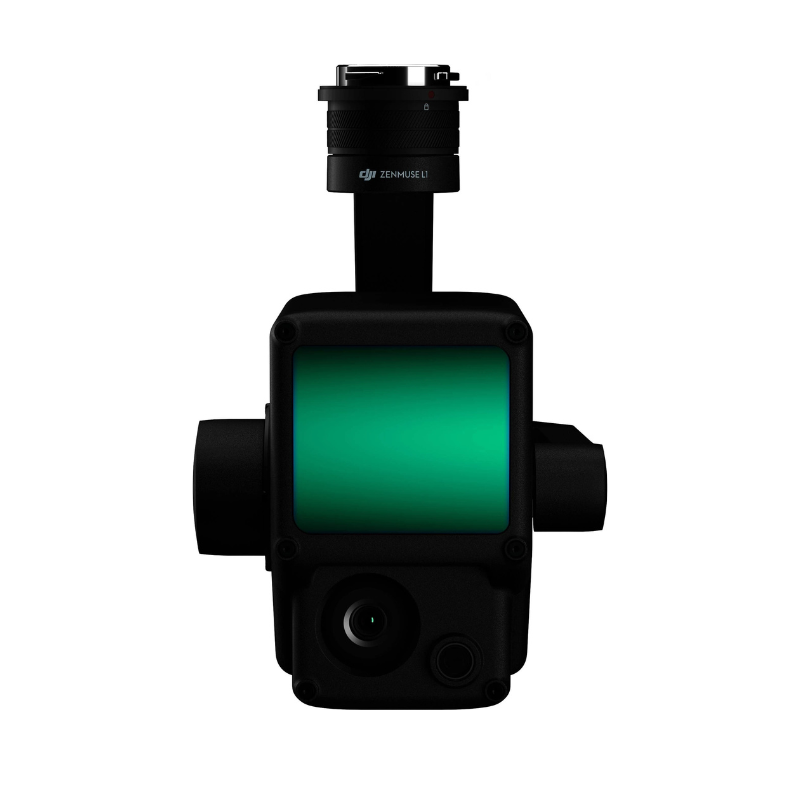
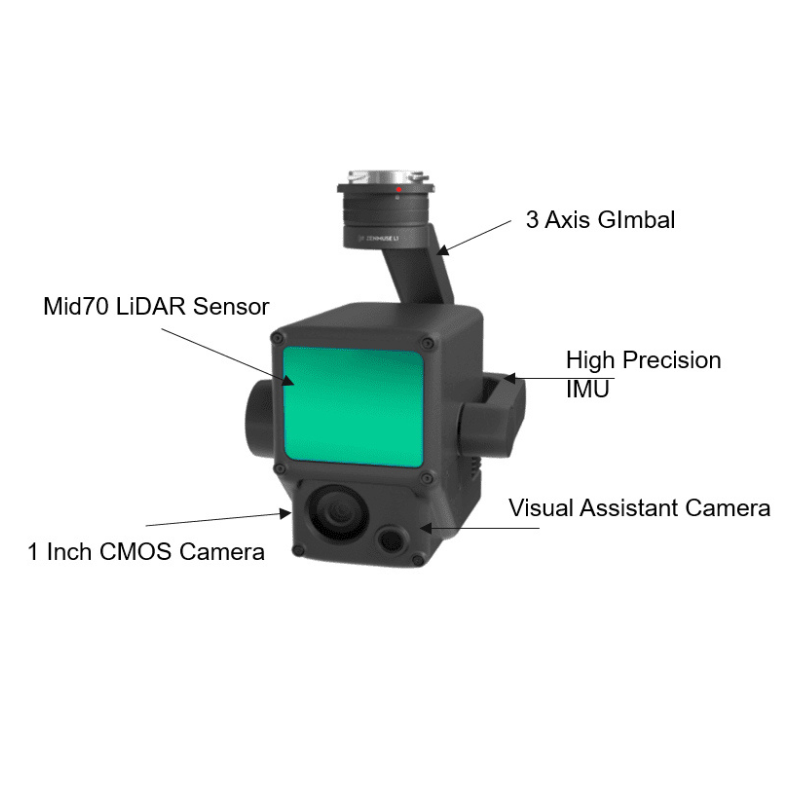
The DJI Zenmuse L1 is not just another payload—it’s a complete aerial LiDAR solution designed for professionals who need accuracy, speed, and reliability. With its Livox LiDAR module, a 1-inch RGB camera, and a high-precision IMU, the L1 delivers real-time 3D data that transforms how industries like surveying, forestry, construction, and infrastructure inspection work with aerial data. Built tough with an IP54 rating, it is ready to handle challenging field conditions while providing crystal-clear point clouds and accurate 3D models.
The L1’s LiDAR system offers a ranging accuracy of up to 3 cm at 100 meters, with a maximum detection range of 450 m at 80% reflectivity. Supporting up to 3 returns and delivering a point rate of 480,000 pts/s in multiple-return mode, it ensures dense and highly accurate mapping data even in complex terrains.
Equipped with a 1-inch CMOS sensor and 20 MP resolution, the RGB camera adds vibrant details to point clouds. With multiple photo sizes, a mechanical shutter, and adjustable aperture from f/2.8 to f/11, it captures true-to-life imagery. Video recording at 4K (3840×2160 30p) ensures seamless integration of visuals into mapping workflows.
With an IMU update frequency of 200 Hz, ±8 g accelerometer range, and yaw accuracy as precise as 0.3° real-time (0.15° in post-processing), the L1 ensures every point cloud dataset is aligned perfectly. This allows surveyors and engineers to trust every measurement in the final model.
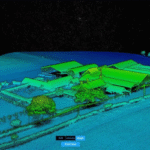
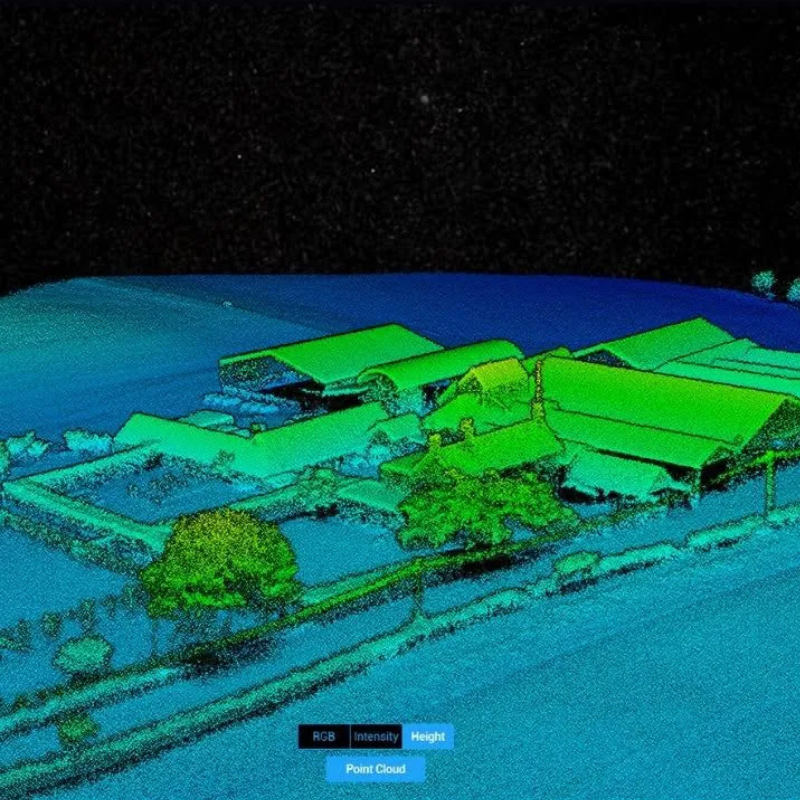
The L1 supports real-time point cloud coloring modes, including reflectivity, height, distance, and RGB. Operators can immediately verify data quality mid-flight, reducing re-flight chances and ensuring complete coverage of critical sites without wasting time.
With an IP54 rating, the Zenmuse L1 is resistant to dust and water, making it reliable in harsh conditions. Whether working in rain, heat, or dusty sites, it continues to perform without compromise. Its operating temperature ranges from -20°C to 50°C, ensuring consistent results in extreme environments.
The L1 integrates seamlessly with DJI Terra, supporting standard point cloud formats such as PNTS, LAS, PLY, PCD, and S3MB. This allows professionals to easily process, analyze, and export data for industry-standard use. From raw point cloud to actionable 3D maps, the workflow remains streamlined.
Forestry, mining, power line inspection, and construction all benefit from the L1’s versatility. With the ability to see through vegetation, capture urban structures, and deliver accurate surface models, it becomes a multipurpose tool for professionals across industries.
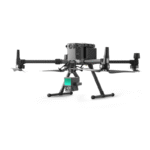
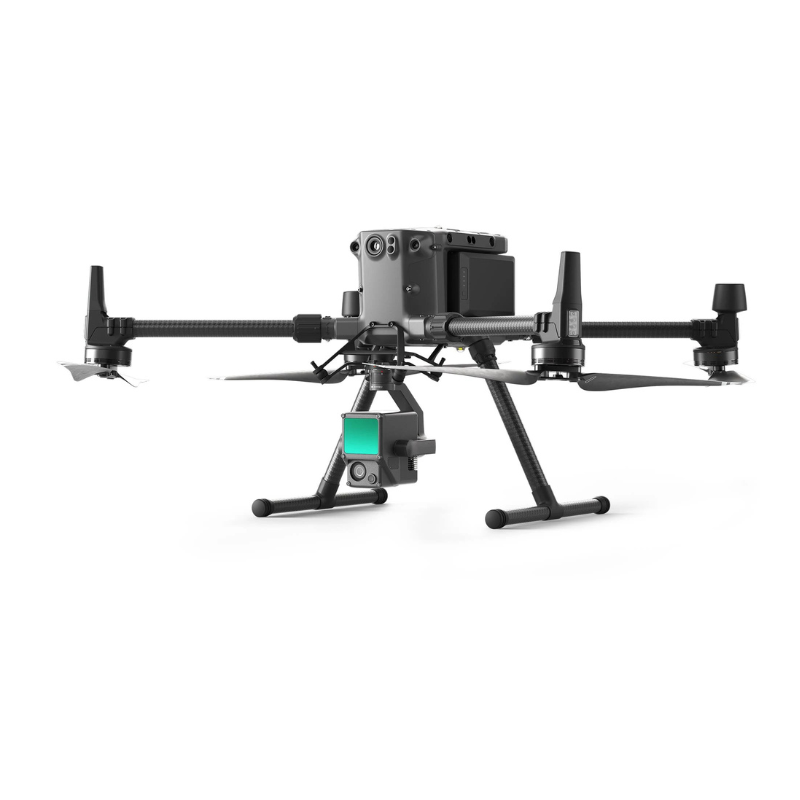
Mount the L1 securely onto the DJI Matrice 300 RTK using the SkyPort connection.
Power on the drone and open the DJI Pilot app to calibrate the sensor system.
Set up mission parameters such as scanning mode, altitude, and coverage area.
Monitor real-time point cloud data during flight to ensure proper area coverage.
After the mission, transfer the collected point cloud, IMU, and RGB data to a workstation for processing in DJI Terra.
Store the unit in a dust-free, dry environment with a stable temperature.
Use padded protective cases during transport to avoid vibrations and shocks.
Update firmware regularly to ensure peak performance and bug fixes.
Handle connectors with care, and always use protective caps when not in use.
Avoid exposure to extreme conditions outside the specified -20°C to 50°C range.
Use a microfiber cloth to gently wipe the LiDAR sensor window and RGB lens.
If required, apply a lens-safe cleaning solution—never harsh chemicals.
Clean dust or dirt around connectors with compressed air.
Avoid touching the optical surfaces with fingers to prevent smudges.
Always clean the sensor after field use before storage to maintain accuracy.
The DJI Zenmuse L1 is a complete aerial LiDAR solution that blends precision, ruggedness, and efficiency into one system. It gives you real-time point clouds, integrates RGB color seamlessly, and ensures professional accuracy that saves both time and resources. If you want reliable 3D mapping in any industry—from forestry to infrastructure—the L1 is a tool that will make your workflow smarter and faster.
The Livox module with non-/repetitive scanning, 1-3 returns, low-light active detection, and frame scanning allows for creating 3D point clouds in real time for mapping or forestry.
450m at 80% reflectivity (0 klx), 190m at 10% (100 klx); 3 cm at 100m; works great in low light without illumination.
10 cm horizontal/5 cm vertical at 50m; IMU 0.025° roll/pitch (post), 0.15° yaw; applicable for topographic and vegetation analysis where precision is needed.
Matrice 300 RTK (right single gimbal port); viewable in Android DJI Pilot, processed with DJI Terra (up to 2km² at a flying height of 100m).
Non-repetitive (H 70.4° × V 77.2°) for detail; repetitive (H 70.4° × V 4.5°) for uniformity; 80-480K pts/sec; Maps/Linear/Oblique/Waypoint modes.
20MP 1-inch CMOS for RGB/reflectivity/color height/distance; 5472 × 3648 JPEG, 4K @30p MOV/MP4; no simultaneous scan/video.
IP54; -20 to 50 degrees Celsius; microSD card (UHS-I Grade 3) will hold a maximum of 256MB for PNTS, LAS, PLY, PCD, and S3MB data; stores GNSS, IMU, and calibration values.
| Specification | Details |
|---|---|
| Product Name | Zenmuse L1 |
| Dimensions | 152 × 110 × 169 mm |
| Weight | 930 ± 10 g |
| Power | Typical: 30 W; Max: 60 W |
| IP Rating | IP54 |
| Supported Aircraft | Matrice 300 RTK |
| Operating Temperature Range | -20° to 50° C (-4° to 122° F) 0° to 50° C (32° to 122° F) (when using RGB mapping camera) |
| Storage Temperature Range | -20° to 60° C (-4° to 140° F) |
| Specification | Details |
|---|---|
| Ranging Accuracy (RMS 1σ)² | 3 cm @ 100 m |
| Maximum Returns Supported | 3 |
| Scan Modes | Non-repetitive scanning pattern, Repetitive scanning pattern |
| FOV | Non-repetitive scanning pattern: 70.4° (horizontal) × 77.2° (vertical) Repetitive scanning pattern: 70.4° (horizontal) × 4.5° (vertical) |
| Laser Safety | Class 1 (IEC 60825-1:2014) (Eye Safety) |
| Specification | Details |
|---|---|
| Resolution | 1280 × 960 |
| FOV | 95° |
| Specification | Details |
|---|---|
| Stabilized System | 3-axis (tilt, roll, pan) |
| Angular Vibration Range | 0.01° |
| Mount | Detachable DJI SKYPORT |
| Mechanical Range | Tilt: -120° to +30°; Pan: ±320° |
| Operation Modes | Follow / Free / Re-center |
| Specification | Details |
|---|---|
| Supported Software | DJI Terra |
| Data Format | DJI Terra supports exporting standard format point cloud models: Point cloud format: PNTS / LAS / PLY / PCD / S3MB |
| Specification | Details |
|---|---|
| Detection Range | 450 m @ 80% reflectivity, 0 klx ;190 m @ 10% reflectivity, 100 klx |
| Point Rate | Single return: max. 240,000 pts/s ;Multiple return: max. 480,000 pts/s |
| System Accuracy (RMS 1σ) | Horizontal: 10 cm @ 50 m ;Vertical: 5 cm @ 50 m |
| Real-time Point Cloud Coloring Modes | Reflectivity, Height, Distance, RGB |
| Specification | Details |
|---|---|
| IMU Update Frequency | 200 Hz |
| Accelerometer Range | ±8 g |
| Angular Velocity Meter Range | ±2000 dps |
| Yaw Accuracy (RMS 1σ) | Real-time: 0.3° ; Post-processing: 0.15° |
| Pitch / Roll Accuracy (RMS 1σ) | Real-time: 0.05° ; Post-processing: 0.025° |
| Specification | Details |
|---|---|
| Sensor Size | 1 inch |
| Effective Pixels | 20 MP |
| Photo Size | 5472×3078 (16:9); 4864×3648 (4:3); 5472×3648 (3:2) |
| Focal Length | 8.8 mm / 24 mm (Equivalent) |
| Shutter Speed | Mechanical: 1/2000 - 8 s ; Electronic: 1/8000 - 8 s |
| ISO | Video: 100 – 3200 (Auto), 100 – 6400 (Manual) ; Photo: 100 - 3200 (Auto), 100 - 12800 (Manual) |
| Aperture Range | f/2.8 - f/11 |
| Supported File System | FAT (≤32 GB); exFAT (>32 GB) |
| Photo Format | JPEG |
| Video Format | MOV, MP4 |
| Video Resolution | H.264, 4K: 3840×2160 30p |
| Specification | Details |
|---|---|
| Raw Data Storage | Photo / IMU / Point cloud data storage / GNSS / Calibration files |
| Supported microSD Cards | microSD with sequential writing speed 50 MB/s or above and UHS-I Speed Grade 3 rating or above; Max capacity: 256 GB |
| Recommended microSD Cards | SanDisk Extreme 128GB UHS-I Speed Grade 3 ; SanDisk Extreme 64GB UHS-I Speed Grade 3 ; SanDisk Extreme 32GB UHS-I Speed Grade 3 ; SanDisk Extreme 16GB UHS-I Speed Grade 3 ; Lexar 1066x 128GB U3 ; Samsung EVO Plus 128GB |

Reviews
There are no reviews yet.